What is AI Agent? A Complete 2026 Guide

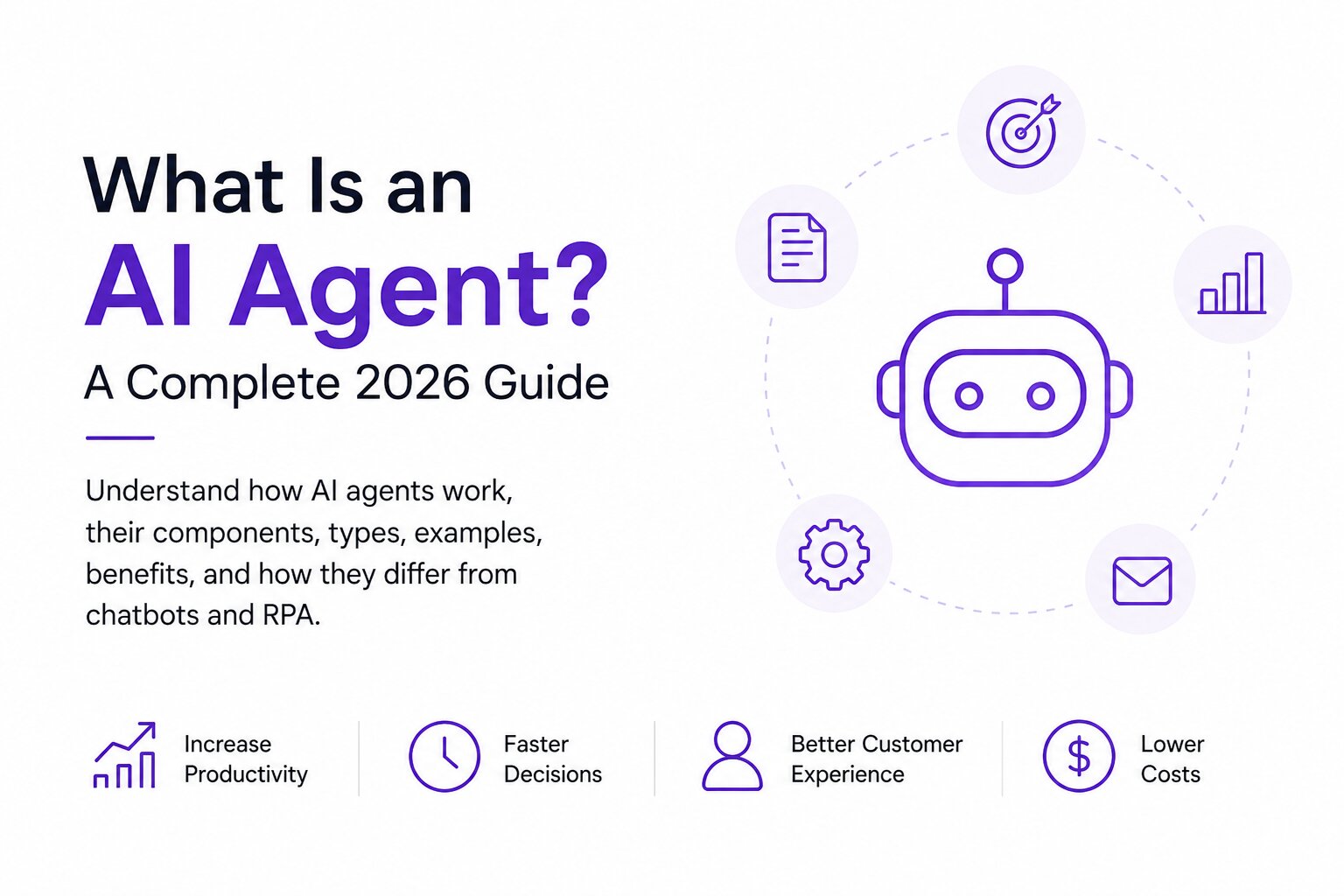
What Is an AI Agent? A Complete 2026 Guide
AI agents are intelligent systems that understand goals and act to achieve targeted outcomes. Unlike traditional software, they can make intelligent decisions and take actions that drive meaningful business outcomes.
They can plan tasks, use digital tools, interact with business applications, and adjust their approach with minimal human intervention.
In 2026, AI agents are becoming execution partners for modern businesses. Organizations use them to automate multi-step workflows, improve decision-making, reduce repetitive work, and deliver faster customer experiences.
This guide explains what an AI agent is, how it works, its core components and types, real-world examples, key benefits, and how AI agents differ from chatbots and robotic process automation (RPA).
How Does an AI Agent Work?
1. Collecting Information
The first step of an AI agent is gathering information from its environment.
AI agents can collect data from:
- User instructions
- Websites
- Databases
- Business applications
2. Understanding and Analyzing Data
After collecting information, the AI agent analyzes the data and determines the best approach.
Using AI models, agents can:
- Understand user intent
- Identify patterns
- Evaluate options
- Make informed decisions
3. Creating a Task Strategy
AI agents create smaller steps and develop a strategy to achieve the desired outcome.
For example:
- Check employee availability
- Find a suitable meeting time
- Schedule the event
- Send notifications
4. Executing Tasks
Once the agent creates a plan, it performs actions to achieve the goal.
Examples include:
- Sending emails
- Updating records
- Creating documents
5. Improving Performance
AI agents can use feedback, previous tasks, and new information to adjust their actions and improve how they complete future tasks.
Real-World Examples of AI Agents in 2026
Personal Assistant AI Agents
Personal assistant AI agents can manage schedules, handle daily tasks, and set reminders.
Example: Siri answers questions and helps with everyday tasks.
Customer Service AI Agents
Businesses use AI agents to handle customer queries, solve problems, and provide support around the clock.
Example: AI-powered chatbots can answer customer questions instantly and provide 24/7 support.
AI Coding Agents
Developers use AI coding agents to generate code and improve software development processes.
Example: Cursor AI helps developers write and edit code faster.
Research AI Agents
Research agents collect information, analyze documents, and summarize complex topics.
Example: Researcher Agent by Allyra.ai finds information and helps answer complex questions.
Business Automation AI Agents
Companies use AI agents to automate repetitive processes such as reporting, data analysis, and administrative work.
Benefits of AI Agents
Increased Productivity
AI agents automate repetitive work and allow employees to focus on strategic activities.
Faster Decision-Making
They can analyze large amounts of data quickly and provide useful insights.
Improved Customer Experience
AI agents provide personalized support and faster responses.
Cost Reduction
Automation helps businesses reduce manual effort and operational costs.
By analyzing data and taking intelligent actions, AI agents help businesses increase productivity and scale workflows more effectively.
What Are the Core Components of an AI Agent?
AI agents rely on several key components to make decisions and perform actions effectively.
Perception
The AI agent gathers information from its environment through user inputs, sensors, documents, or APIs.
Planning
The agent breaks a complex task into smaller steps and creates a strategy to achieve the objective.
Memory
Memory allows the AI agent to store previous interactions that help it provide more relevant responses.
Action
The AI agent executes tasks by interacting with external tools or systems, such as sending emails or updating records.
Learning
Learning helps the agent improve its performance by receiving feedback and incorporating new information.
Types of AI Agents
Reactive Agents
- Respond to current inputs without storing past data.
- Best suited for simple, rule-based tasks.
Research Agents
- Gather, analyze, and summarize information from multiple sources.
- Example: A market research agent preparing a competitor analysis.
Personal Assistant Agents
- Manage individual tasks and schedules.
- Examples:
- Email drafting
- Reminder handling
How Is an AI Agent Different From a Chatbot?
AI Agent
An AI agent is an intelligent system that understands goals and takes actions to complete tasks.
Key characteristics:
- Takes actions to complete tasks
- Creates plans and workflows
- Works toward a specific goal
Chatbot
A chatbot is a conversational AI system that responds to user questions and provides information.
Key characteristics:
- Mainly provides responses
- Focuses primarily on conversations
- Answers user questions
Conclusion
AI agents are transforming the way organizations operate by automating tasks and providing faster insights. They enhance user experiences and support smarter decisions.
Successful implementation requires proper data management and strong security measures. Human supervision is essential to ensure accuracy, fairness, and responsible use.
FAQs
It is intelligent software that helps analyze data, make informed decisions, and perform regular tasks automatically with minimal manual input.
Yes, AI agents generally need human supervision to ensure accuracy, safety, and ethical decision-making.
There are multiple examples of AI Agents that include SalesMate for ai-calling, lead qualification, HRHub for onboarding a candidate to offboarding and more.
AI agents are widely used in industries like recruitment, sales, customer support, marketing, healthcare, finance, and IT.
Yes, ai agents are built to provide continuous support and respond to candidate queries anytime.
An AI agent can make decisions autonomously, while RPA follows rules to automate repetitive tasks.